
Manufacturing earthenware, stoneware, and porcelains area a highly technical kind of manufacturing. To fire all these kinds of materials, you need to understand a lot about the kiln and the correct firing temperature.
If a ceramic piece is not fired at the correct temperature, it will significantly affect the final product’s outcome. It is also essential that the correct kiln is used for the production process. This is because many things must be considered when using a kiln to fire ceramics. Many things can cause the final product to fail or crack during the firing process.
Table of Contents
- All About A Ceramic Kiln
- All about Firing Ceramic Products
- Gốm sứ & Giải thích về Nhiệt độ Nung
- Living Vietnam/ Về Living Vietnam
- Related Content
All About A Ceramic Kiln
To understand why the firing temperature will affect the final product, we must first understand what a ceramic kiln is. The best way to describe a ceramic kiln is a giant oven that will bake your ceramics just like you would bake a cake in your home oven.
The technical definition of a ceramic kiln is:
A thermally insulated chamber, a type of oven, that produces temperatures sufficient to complete some process, such as hardening, drying, or chemical changes.
wikipedia
Some form of ceramic kiln has been used for 1,000s of years. These kilns have turned various objects made by clay into pottery, tiles, or bricks.
Some forms of manufacturing may still use kilns that are heated by a wood source or fire. Usually, I have seen wood or fire kilns in factories that need to have the wood or fire to get the finish they desire or due to the clay, they are using. But most kilns today use gas or electricity as their heat source. The reason is that this is usually safer and more economical.
Today there are so many ways kilns are built. That is why just the kiln itself to fire your ceramics can be extremely technical.
Whatever the kiln’s heat source, a kiln must be able to high-fire the clay at temperatures sufficient enough and even enough so that a clay reaction will occur and the body of the clay will be permanently altered into a hardened state.
But not all kilns are created equal; some kilns will work better than others. Here are a few things to remember about a kiln:
- Temperatures – The kiln must be able to fire extremely high temperatures safely. For example, porcelain should fire at 1200C (2190F) to 1400 C (2550F). Due to these very high temperatures, porcelain is scratch-resistant and extremely hard.
- Unequal heat in kiln- Not all kiln heat is the same unless you have an extremely high-tech kiln where they have worked to get the kiln as equal as possible.
- Placement in kiln- Since the heat in most kilns can be a bit unequal, even just a few degrees or less for some finishes can affect the color finished or hardness of the product. This is why we say that ceramic production is very complicated.
If you are interested in finding out more about the firing temperatures for different clay types, you can read our blog Earthenware, Stoneware, and Porcelain Materials by clicking here.
All about Firing Ceramic Products
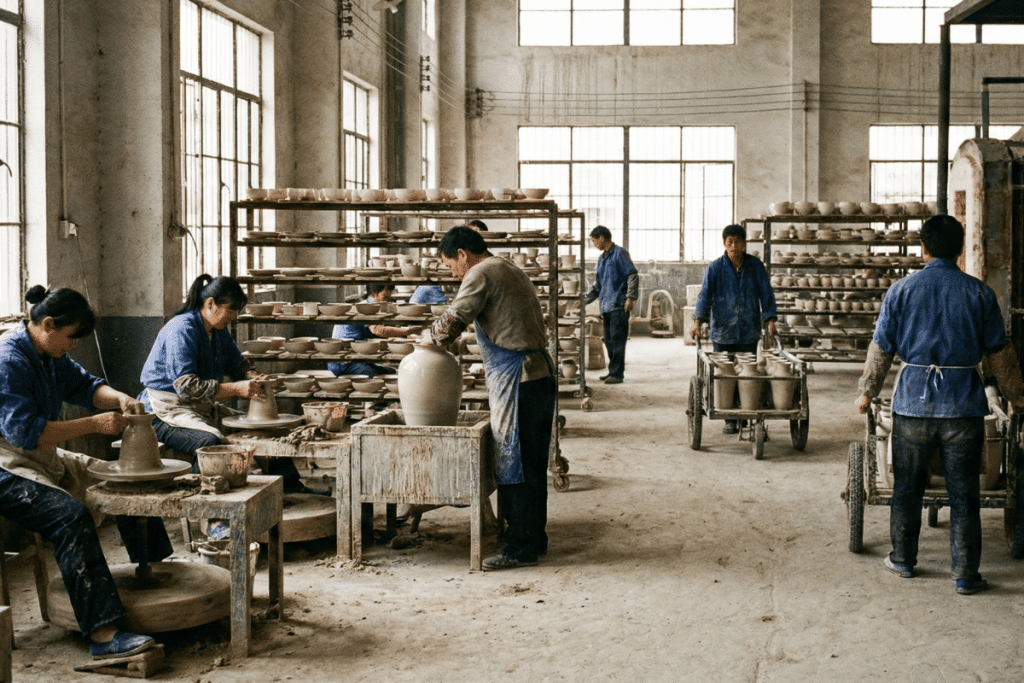
Just forming the shape in the clay is not enough. Once that shape has been formed, then the clay must be fired. The firing of the clay can change the clay in a lot of profound ways. Essentially during firing, the clay goes from a soft, fragile substance to one that is rock-hard and solid.
Here are some things to understand about clay and the kiln firing process:
Bone-Drying in the Atmosphere
After the clay is formed, it is almost always dried to become what is known as bone-dried. Bone-dry is defined as:
“Bone dry (adjective) is a term used to describe and identify greenware pottery that has dried as much as possible before it has gone through its first firing (the bisque firing). When held, bone dry greenware feels to be at room temperature, not cool to the touch.”
The Spruce Crafts
I can tell you from first-hand experience that pottery is still very fragile at this stage. It will break into pieces if you do not pick the pottery up correctly. The clay may be dried, but the pottery has not yet gone through the process to be changed through the firing process.
Making the clay bone-dry is just the first step in the firing process. The clay is now shaped and bone-dried. Bone-dry the clay by leaving the clay out for at least a few days or, in some cases, longer. The idea is to get the clay to be as dry as possible.
Here are a few things about bone-dried clay:
- Bone-dry – Completely dried out unfired clay.
- Brittle and fragile – The clay is still very brittle and fragile in this state. It needs to be handled as little as possible.
- Usually lighter – The color will change, and the clay is lighter than in the moist state.
- Can not add anything – Once the clay is bone-dry, nothing can be added except some careful scratching or polishing.
- Difficult to re-wet – At this point is difficult to re-wet and to re-work the piece. But if you carefully rewet it evenly over the entire piece, sometimes you can rework it a bit. This is why making any changes before the clay is bone-dry is best. If you made a mistake, it is usually easier to start over than to re-wet a bone-dried piece.
Once the clay is fully bone-fried, it can be put in the kiln to be fired. Once it is in the kiln, several changes take place.
Fire to Burn Off the Carbon and Sulfur
You must fire the clay to burn off the carbon and sulfur content in the clay. All clay will have some carbon and sulfur that must burn off in the firing process. If this cannot burn off properly, carbon or black coring can occur. This is generally not desirable as it will weaken the structure of the clay.
Carbon coring or black coring happens when:
“A gray or black layer under the surface of a fired clay piece. Carbon or black coring is undesirable, as it makes the piece weaker, can discolor glazes, and is associated with bloating.”
Flye school
Carbon coring can happen if the firing is too fast or the kiln is poorly ventilated, so there is not enough oxygen in the kiln. Black or grey coring happens when the carbon and sulfur will strip away any red iron from the clay body, turning it into a black color.
Water Needs to Be Taken Out – Quartz Inversion.
Clay can still have close to 14% of water after it is considered to be bone-dried. When the clay is fired, the water needs to be able to escape from the clay. But if the water is taken out too quickly, it can cause steam inside the clay. This will essentially break the clay pieces in the kiln. Quartz Inversion is when the water is taken out too quickly.
Expansion and Contraction of Clay-Dunting
When the clay is being heated up, it can temporarily expand in size to about 1- 2% during the heating process, and then it will contract to about 1-2% during the cooling process. If the ceramic is heated or cooled too quickly, it will cause the pottery cracking. This kind of cracking is called dunting. You can identify dunting cracks as the ceramic piece will usually be warped, and the cracked edges will not fit together.
Clay Partials Sticking Together – Sintering
Another thing that happens in the kiln is that the clay particles will start sticking or fusing together. They call this process of the clay fusing sintering. During sintering, the clay stops becoming clay but becomes a ceramic or porcelain material.
Fired to Mature or Vitrify Structure
A mature and vitrify structure is when the clay is fired so that it is hard enough to be used. Mature means that you have fired the clay to a tight, hard, and serviceable kind of structure.
On the other hand, Vitrify is similar to mature but not the same, for a lump of clay to vitrify means that it is fired to the point of glassification or turned more into a glass-like substance. Porcelain is fired at such a high temperature so it is considered vitrified.
There are many ways that the kiln firing process will affect the production of earthenware, stoneware, and porcelain materials that are used in ceramic production. The kind of kiln you use and how the piece is fired can make a huge difference in the final ceramic product’s outcome.
Gốm sứ & Giải thích về Nhiệt độ Nung
Sản xuất đồ gốm đất nung, sành và sứ là một loại hình sản xuất đòi hỏi kỹ thuật rất cao. Để nung các loại vật liệu này, bạn cần hiểu rõ về lò nung và nhiệt độ nung phù hợp.
Nếu một sản phẩm gốm không được nung ở nhiệt độ đúng, điều này sẽ ảnh hưởng đáng kể đến kết quả cuối cùng của sản phẩm. Ngoài ra, việc sử dụng đúng loại lò nung cũng rất quan trọng trong quá trình sản xuất. Điều này là do có rất nhiều yếu tố cần được xem xét khi sử dụng lò nung để nung gốm. Nhiều yếu tố có thể khiến sản phẩm cuối cùng bị hỏng hoặc nứt trong quá trình nung.
Để hiểu tại sao nhiệt độ nung lại ảnh hưởng đến sản phẩm cuối cùng, trước tiên chúng ta cần hiểu lò nung gốm là gì. Cách đơn giản nhất để mô tả lò nung gốm là một lò nướng khổng lồ, nó sẽ nướng gốm của bạn giống như cách bạn nướng bánh trong lò nướng gia đình.

Định nghĩa kỹ thuật của lò nung gốm:
“Lò nung là một buồng cách nhiệt, một loại lò, có thể tạo ra nhiệt độ đủ cao để hoàn thành một số quá trình, chẳng hạn như làm cứng, sấy khô hoặc thay đổi hóa học.” (Wikipedia)
Một số dạng lò nung gốm đã được sử dụng trong hàng nghìn năm. Những lò này đã biến các vật thể làm từ đất sét thành đồ gốm, gạch hoặc ngói.
Một số hình thức sản xuất vẫn sử dụng lò nung đốt bằng củi hoặc lửa. Thông thường, tôi đã thấy các lò nung bằng củi hoặc lửa trong các nhà máy cần sử dụng nguồn nhiệt này để đạt được bề mặt hoàn thiện mong muốn hoặc do loại đất sét mà họ sử dụng. Tuy nhiên, hầu hết các lò nung ngày nay sử dụng khí đốt hoặc điện làm nguồn nhiệt. Lý do là vì điều này thường an toàn hơn và kinh tế hơn.
Ngày nay, có rất nhiều cách để xây dựng lò nung. Đó là lý do tại sao chỉ riêng lò nung đã là một phần rất kỹ thuật trong việc nung gốm của bạn.
Bất kể nguồn nhiệt của lò nung là gì, lò nung phải có khả năng nung đất sét ở nhiệt độ đủ cao và đồng đều để phản ứng hóa học xảy ra, làm thay đổi cấu trúc của đất sét thành trạng thái cứng vĩnh viễn.
Tuy nhiên, không phải tất cả các lò nung đều giống nhau; một số lò hoạt động tốt hơn những lò khác. Dưới đây là một vài điều cần nhớ về lò nung:
- Nhiệt độ: Lò nung phải có khả năng nung ở nhiệt độ cực cao một cách an toàn. Ví dụ, sứ cần được nung ở nhiệt độ từ 1200°C (2190°F) đến 1400°C (2550°F). Nhờ nhiệt độ cực cao này, sứ có khả năng chống trầy xước và rất cứng.
- Nhiệt độ không đồng đều trong lò: Không phải tất cả lò nung đều có nhiệt độ đồng đều, trừ khi bạn sử dụng loại lò công nghệ cao, nơi mà nhiệt độ được phân bố đều nhất có thể.
- Vị trí trong lò: Do nhiệt độ trong hầu hết các lò nung có thể không đồng đều, ngay cả sự chênh lệch vài độ cũng có thể ảnh hưởng đến màu sắc hoặc độ cứng của sản phẩm. Đây là lý do tại sao sản xuất gốm sứ rất phức tạp.
Nếu bạn muốn tìm hiểu thêm về nhiệt độ nung cho các loại đất sét khác nhau, bạn có thể đọc blog của chúng tôi về Nguyên liệu Gốm đất nung, Sành, và Sứ tại
Tất cả về Quá trình Nung Sản Phẩm Gốm
Chỉ tạo hình đất sét thôi là chưa đủ. Sau khi tạo hình, đất sét cần được nung. Quá trình nung đất sét có thể thay đổi đất sét theo nhiều cách sâu sắc. Về cơ bản, trong quá trình nung, đất sét chuyển từ một chất mềm, dễ vỡ sang trạng thái cứng rắn như đá.
Một số điều cần hiểu về đất sét và quá trình nung lò:
Giai đoạn Khô Xương trong Không Khí
Sau khi đất sét được tạo hình, nó thường được làm khô đến trạng thái gọi là “khô xương”.
Khô xương được định nghĩa là:
“Khô xương (tính từ) là thuật ngữ dùng để mô tả và xác định đất sét chưa nung đã khô đến mức tối đa trước khi trải qua lần nung đầu tiên (nung bisque). Khi cầm, đất sét khô xương sẽ có cảm giác ở nhiệt độ phòng, không mát khi chạm vào.” (The Spruce Crafts)
Ở giai đoạn này, gốm vẫn rất dễ vỡ. Nó có thể vỡ thành nhiều mảnh nếu bạn không cầm đúng cách.
Những điều cần biết về đất sét khô xương:
- Khô hoàn toàn: Đất sét chưa nung đã khô hoàn toàn.
- Dễ vỡ: Đất sét rất dễ vỡ và cần được xử lý cẩn thận.
- Màu sáng hơn: Màu sắc của đất sét sẽ nhạt hơn so với trạng thái ẩm.
- Không thể thêm gì: Không thể thêm bất kỳ thứ gì vào đất sét khô xương, ngoại trừ một số thao tác đánh bóng hoặc cào nhẹ.
- Khó làm ướt lại: Đất sét khô xương rất khó làm ướt lại và chỉnh sửa.
Living Vietnam/ Về Living Vietnam
Living Vietnam offers high-quality home decor and furniture items that meet export standards. We specialize in unique, hard-to-find pieces, many of which are one-of-a-kind. To explore our collection, visit our Facebook and Instagram pages. Don’t miss the opportunity to own premium home decor at exceptional prices!
Living Vietnam cung cấp các sản phẩm trang trí nội thất và đồ nội thất chất lượng cao đạt tiêu chuẩn xuất khẩu. Chúng tôi chuyên về các món đồ độc đáo, khó tìm, trong đó nhiều món là hàng độc nhất vô nhị. Để khám phá bộ sưu tập của chúng tôi, hãy ghé thăm trang Facebook và Instagram của chúng tôi. Đừng bỏ lỡ cơ hội sở hữu những món đồ trang trí nội thất cao cấp với mức giá hấp dẫn!
Related Content
Silk Creations: Exploring the Many Things You Can Make with Silk
Silk is a luxurious and versatile fabric that has been around for thousands of years. It has been used in a variety of industries, including fashion, home decor, and even for military purposes. In this article, we will explore how silk fabric can be used and its rich history.
Sáng Tạo Với Lụa: Khám Phá Những Điều Tuyệt Vời Có Thể Làm Từ Lụa
Lụa là một loại vải sang trọng và đa năng đã tồn tại hàng ngàn năm. Nó đã được sử dụng trong nhiều ngành công nghiệp, bao gồm thời trang, trang trí nội thất, và thậm chí cả trong lĩnh vực quân sự. Trong bài viết này, chúng ta sẽ khám phá cách vải lụa được sử dụng và lịch sử phong phú của nó.
Read more at https://mondoroliving.com/silk-creations-exploring-the-many-things-you-can-make-with-silk/